Platform Governance
Part of Ecommerce platform security and access
Planning emergency access after an administrator leaves
Prepare an ecommerce administrator handover, secure departing staff access and identify supported account recovery routes.
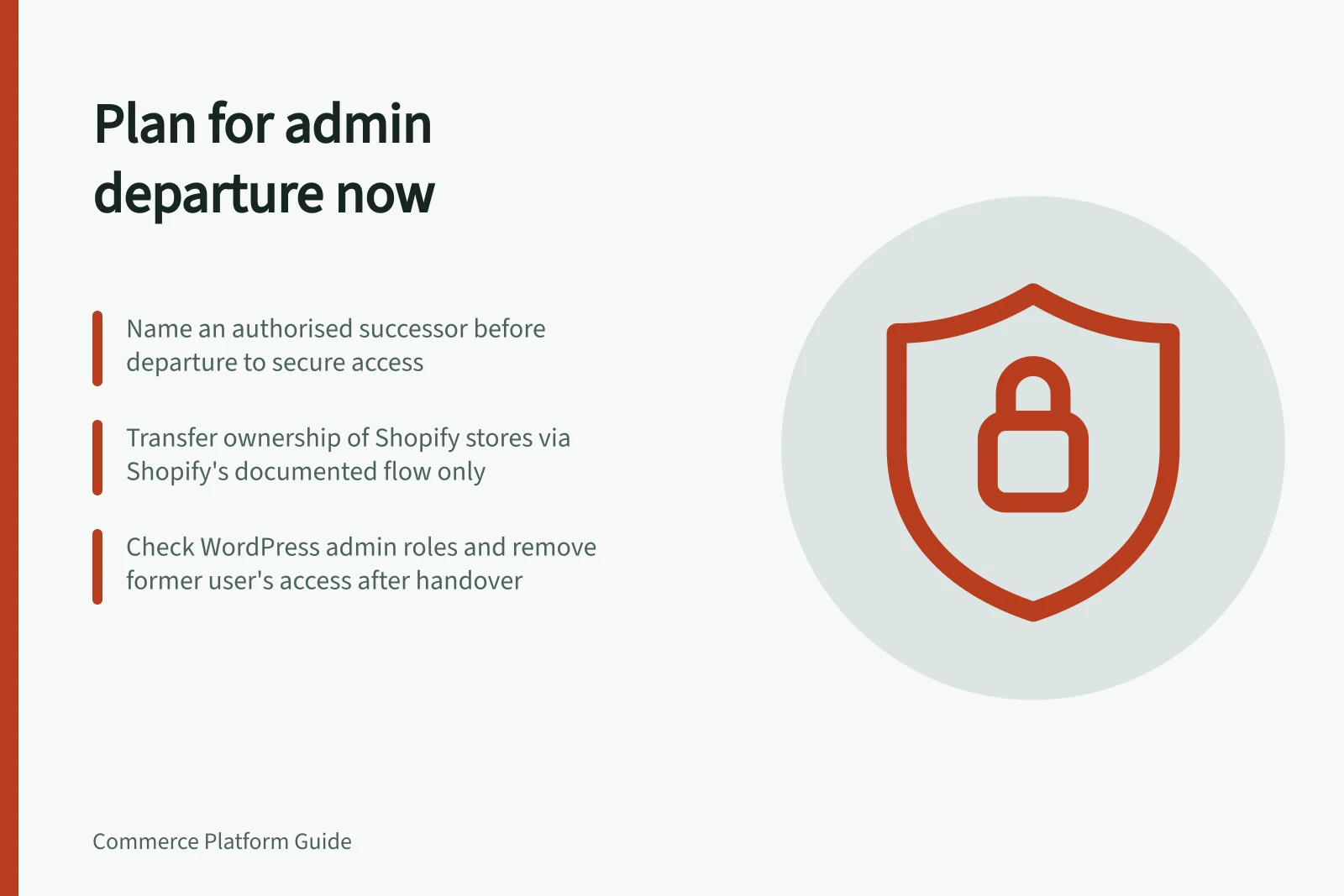
Plan administrator succession while current account holders can still act. Name an authorised successor, identify the accounts they will need and complete supported transfers before a planned departure.
If someone leaves unexpectedly, secure access the business already controls and establish the supplier's available recovery process. A shared password is not a reliable succession plan.
Find accounts that can block trading
List the commerce admin, domain registrar, hosting service if applicable, payment provider, business email, critical apps and backup service. For each, record the account holder, business contact, recovery method and actions reserved for that holder. Store this record where authorised successors can reach it securely.
Flag services registered to a personal email address or phone. A departure can otherwise block a payout change, domain renewal or app update. Transfer each service through its own supported process before removing the departing person's access.
Complete a planned handover
A Shopify store has one owner. Only that owner can change ownership to an existing user or initiate a transfer to someone outside the store through Shopify's documented flow.
Confirm the recipient's access and review billing, payout, domain and third-party service contacts. Assigning another administrator does not change store ownership.
For WooCommerce, check WordPress administration and hosting separately. Shop Manager can run many store tasks but lacks full WordPress Administrator access.
Establish an authorised successor account and check which plugins, payment services and hosting controls the departing person held. WordPress's Users screen displays the number of posts written by each user and allows users to be deleted. Check any associated content before proceeding.
Have the successor sign in with their own account and complete a harmless required action. Confirm their recovery contact and available second-factor method.
Shopify vs WooCommerce Administrator Roles
- Shopify Owner
- Can transfer ownership only; cannot be changed by other admins
- Shopify Admin
- Can manage users and settings but cannot change ownership
- WooCommerce Shop Manager
- Can run store tasks but lacks full WordPress Administrator access
- WordPress Administrator
- Has full control over site, plugins, themes and user management
Respond to an unexpected departure
Determine which authorised accounts still work. An eligible Shopify user manager can suspend the former user and revoke device access.
Review other credentials the person controlled, including hosting and connected services. If the former person remains the Shopify store owner, another administrator cannot use the documented transfer flow.
Contact Shopify to establish whether any authorised process is available for the specific circumstances. Shopify's login guidance says support assists the store or organisation owner with login issues, so staff should not assume support can simply grant them owner access.
For WordPress, the ordinary password reset uses the account's configured email. WordPress also documents methods involving server or database access. Assign such work to an authorised host or technical operator with appropriate access.
Review integrations before revoking credentials. WooCommerce API keys are tied to WordPress users. Identify which services use a credential and arrange a replacement so revocation does not silently interrupt order or stock flows.
Close the handover
Record access removed, ownership transferred, remaining temporary access and the person responsible for each service. Check billing, payment, domain and recovery contacts. If there is evidence of unauthorised use, follow the business's security and privacy incident procedures.
Keep the succession record described above current when owners, agencies or critical apps change.