Platform Governance
Part of Headless commerce
Planning content and commerce ownership across systems
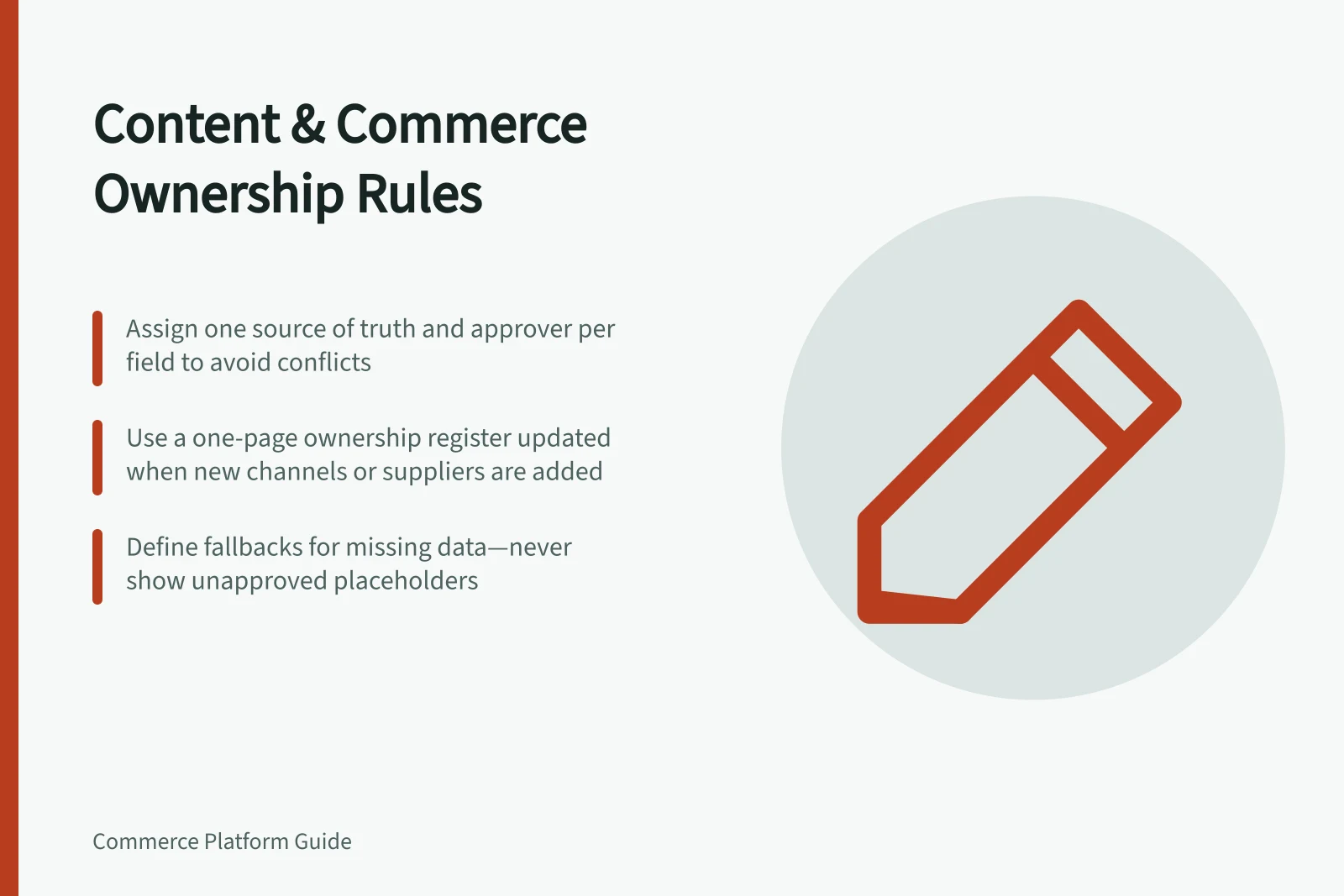
When content and commerce live in separate systems, assign one source of truth for each field and one person who approves its publication.
When content and commerce live in separate systems, assign one source of truth for each field and one person who approves its publication. Without that map, an editor may update a product claim in the CMS while an older claim remains on the commerce product record, checkout or another channel. The storefront can combine the data, but it cannot decide which conflicting statement is correct.
Inventory the fields customers see
List product name, description, images, specifications, price, availability, promotion text and legal or service conditions. For each, record the authoritative system, editor, approver and channels that display it. A brand story may belong in the CMS, while inventory and cart eligibility come from the commerce backend. Some fields may need synchronisation; do not assume a copy will stay accurate without a rule.
Prevent two editors from owning one fact
Suppose a product material changes. If merchandising updates the commerce record but the editorial page contains a hand-written older material claim, both may appear in one shopping journey. Decide whether the CMS should reference the commerce field or whether a scheduled review will update editorial copy.
For important claims, direct reference is often safer, but it may reduce editorial flexibility. Make the trade-off visible.
Define what happens when one system has no value. A missing size or image should not prompt the front end to display an unapproved placeholder as though it were final. Specify a fallback that is truthful and useful, such as hiding an incomplete module or holding publication until the required field is supplied.
Approach options for managing shared facts (e.g., product material claims)
- Direct reference from CMS to commerce system
- Ensures accuracy but reduces editorial flexibility
- Scheduled editorial review and update
- Allows creative freedom but risks outdated content
Plan preview and release
An editor should be able to preview a campaign using the intended products and market settings before launch. Ask whether unpublished content can be viewed alongside products that are not yet available in the sales channel. Shopify's Hydrogen deployments provide preview URLs for testing and approval before production. Test the actual combination, not each system in isolation.
Record the release sequence: product data, content, front-end code and final checkout check. If the release fails halfway, who pauses it and who rolls back which part? A front-end snapshot may be reversible while a product price change has already propagated to other channels. The plan should specify the safe customer state during that gap.
Keep an ownership register small and current
A one-page table is enough to start: field, system of record, responsible team, approval rule, update path and failure contact. Review it when a new channel or supplier is added. For a disputed field, name one accountable decision-maker; keep the last approved value live until that person resolves the conflict.
Ownership register essentials (one-page summary)
- Fields tracked
- Product name, description, images, specifications, price, availability, promotions, legal conditions
- Systems involved
- CMS (content), commerce backend (product data), storefront (presentation)
- Approval rule
- One accountable decision-maker per disputed field
- Fallback policy
- Hide incomplete modules or hold publication until required data is provided