Platform Selection
Choosing an ecommerce platform for an Australian store
Compare ecommerce platforms using your real catalogue, Australian checkout, integrations, costs and ongoing responsibilities.
Start with the orders your store must take and the work your team can maintain. A platform is a credible choice when your products, Australian checkout, delivery rules and connected systems work in the plan and configuration you would buy. A feature list alone cannot establish that.
Write the requirements first
Take a small sample of real products and orders. Include an ordinary item, your most awkward product, a delivery exception and an order staff must correct after purchase. Record what the customer should see and what staff need to do.
| Decision area | Requirement to record |
|---|---|
| Catalogue | Which choices represent separate stock items, and which are custom requests? |
| Checkout | Which payment methods, delivery destinations and tax settings must work? |
| Operations | Who changes products, fulfils orders, handles refunds and resolves failures? |
| Connections | Which accounting, stock or fulfilment system needs order data, and which system owns each field? |
| Change | What must staff be able to alter after launch without a developer? |
Mark each requirement essential, useful or optional. For an essential requirement, ask to see it working in the proposed setup. If it relies on an app or custom work, include its cost and maintenance owner.
Requirements to record before you shortlist
- Cataloguewhich choices are separate stock items and which are custom requests?
- Checkoutthe payment methods, delivery destinations and tax settings that must work
- Operationswho changes products, fulfils orders, handles refunds and resolves failures
- Connectionswhich accounting, stock or fulfilment system needs order data, and which system owns each field
- Changewhat staff must be able to alter after launch without a developer
Four starting points
Compare each platform against the same requirements rather than treating this list as a ranking.
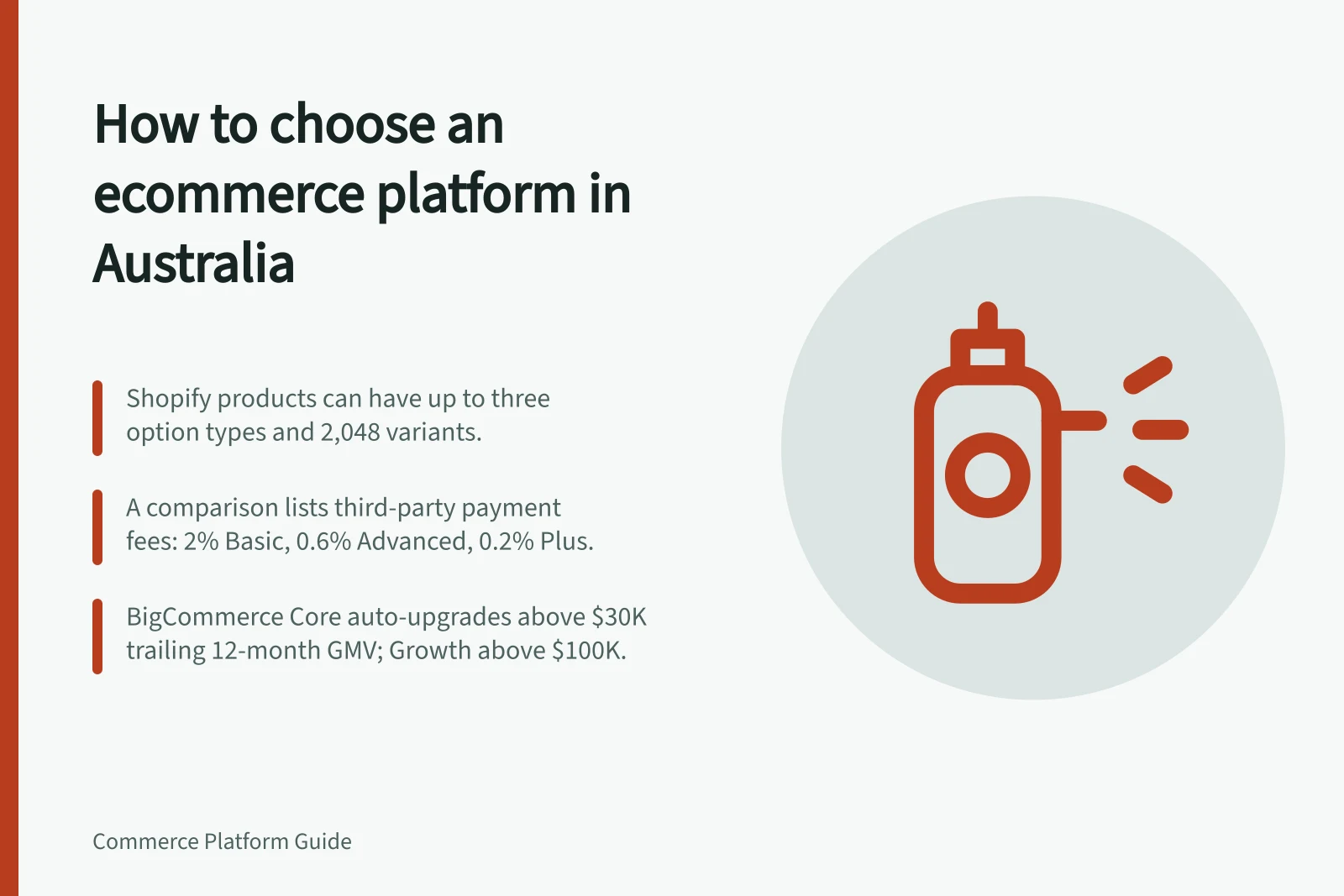
Shopify includes hosting in its plans. Its products can have up to three option types and 2,048 variants.
A cross-platform pricing comparison lists an additional fee for using a third-party payment solution: 2% per transaction on Basic, 0.6% on Advanced and 0.2% on Plus.
WooCommerce is free, open-source software for WordPress. The merchant chooses hosting and may pay for extensions. Variable products can carry prices, stock, image and other settings by variation. Assign responsibility for backups and updates.
BigCommerce provides hosted commerce software. Its catalogue supports variant options that shoppers can select. Its Core and Growth plans use trailing sales thresholds that can trigger an automatic upgrade.
BigCommerce lists zero fees with Embedded Payment Providers on its plans. Obtain the applicable Australian terms for the intended plan.
Adobe Commerce may suit a business with defined customisation needs and people to implement and operate them.
Establish the deployment and continuing duties before comparing a proposal with the other options.
Check plan-level fit
Plan allowances can affect the shortlist even when the platform meets the store's functional requirements. Shopify lists up to 5 staff accounts on Grow, up to 15 on Advanced and unlimited staff accounts on Plus. Compare these allowances with the people who need access.
BigCommerce's sales thresholds are based on trailing 12-month GMV: Core allows up to $30K before an automatic upgrade to Growth, and Growth allows up to $100K before an automatic upgrade to Scale. Its Scale plan lists a $33,333 monthly GMV cap and a 0.9% charge on GMV above the cap. Consider whether those thresholds suit the store's expected sales.
BigCommerce lists real-time shipping quotes with Australia Post among the carrier options.
Plan-level limits worth checking against your store
- Shopify Grow — staff accountsUp to 5
- Shopify Advanced — staff accountsUp to 15
- Shopify Plus — staff accountsUnlimited
- BigCommerce Core — upgrade threshold$30K trailing 12-month GMV before automatic upgrade to Growth
- BigCommerce Growth — upgrade threshold$100K trailing 12-month GMV before automatic upgrade to Scale
- BigCommerce Scale — GMV cap$33,333 monthly GMV cap, then 0.9% on GMV above the cap
Run a comparable demonstration
Give each shortlisted provider or implementer the same products and expected outcomes. Ask them to create the complex item, change its stock, complete the intended Australian payment and delivery path, issue a refund and show the resulting order data.
Include a failure case, such as an unavailable variant or an order feed that stops updating. Record what the customer sees and who fixes the problem.
Use the proposed plan, theme, apps, payment provider and shipping setup. Showing prices in AUD does not establish that the intended payment and delivery paths work.
A comparable demonstration script
- Give every shortlisted provider or implementer the same products and expected outcomes.
- Ask them to create your most awkward item in the proposed plan, theme, apps, payment provider and shipping setup.
- Change that item's stock and confirm what the customer sees.
- Complete the intended Australian payment and delivery path.
- Issue a refund and show the resulting order data.
- Add a failure casean unavailable variant or an order feed that stops updating — and record who fixes it.
Compare the whole commitment
Request a written account of platform fees, payment charges, hosting where separate, apps, implementation, integration work and ongoing support. Record unknown amounts rather than inventing estimates. Price the same required workflow across candidates.
Name the owner of routine product changes, software updates, access, backups, integrations and incident response. Hosted and self-hosted arrangements divide these duties differently, but every store needs accurate product data and trading rules.
Keep a short decision record: required scenarios, what each demonstration showed, unresolved gaps, quoted recurring costs and the owner of each operational duty.
What to request in writing before you commit
- Platform fees
- Payment charges
- Hosting, where it is separate
- Apps and extensions
- Implementation
- Integration work
- Ongoing support
- A named owner for product changes, software updates, access, backups, integrations and incident response
In this guide
- Hosted ecommerce versus self-hosted softwareCompare hosted and self-hosted ecommerce by assigning responsibility for hosting, updates, backups, support and store changes.
- Matching platform requirements to a store's catalogueTurn real products, variants and custom choices into catalogue requirements you can check in an ecommerce platform.