Total Cost
Part of Ecommerce platform costs
Estimating app and integration costs before launch
Budget for app subscriptions, usage fees, setup, data mapping and support before opening an ecommerce store.
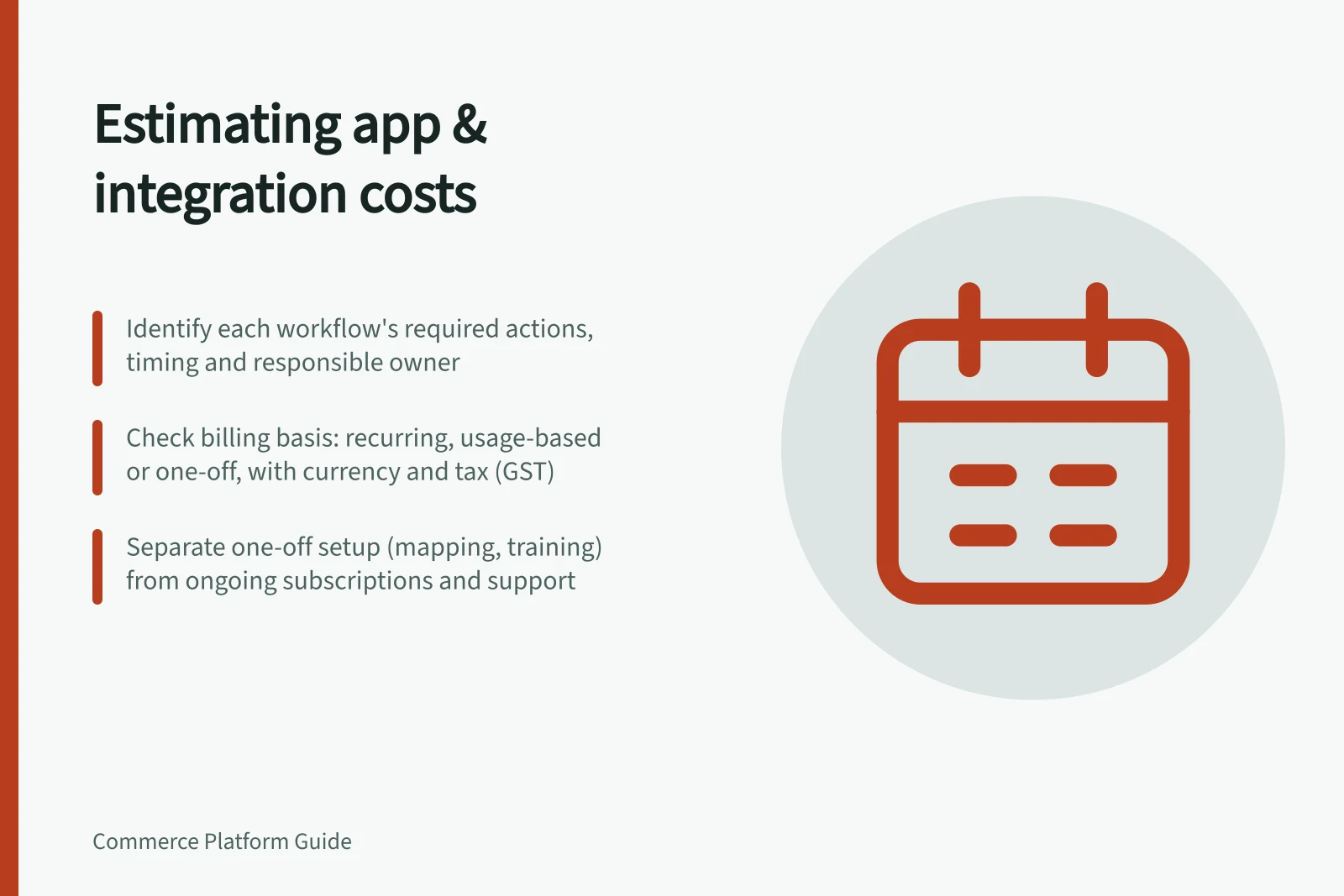
Price an app or integration by the job it must do, its billing basis and the work to keep it running. A marketplace price may cover software only, not data mapping, setup or support. Before choosing a product, build a cost line for each required workflow.
Start with the workflow
Write down what must happen when a product, customer or order changes. If an order must reach accounting, for example, specify the fields, timing and who is responsible when a transfer fails. Check whether the proposed platform plan already performs the task; price an addition only for the remaining gap.
Record / Question to answer
- Business task
- What event must produce what result?
- Solution
- Built-in feature, app, extension or custom connection?
- Setup
- What configuration, mapping and training are needed?
- Recurring cost
- What subscription, hosting or support charge applies?
- Variable cost
- What unit triggers a higher charge?
- Owner
- Who monitors errors, updates the connection and handles cancellation?
A quoted entry tier may allow fewer orders, contacts or messages than the intended store needs. Check the next tier and the terms for retrieving data if the service is removed.
Check billing where it actually occurs
For each Shopify app, ask the developer to identify the charge basis (for example, recurring, usage-based or one-off), who bills it and the billing cycle. Before launch, confirm where to find current plan and billing details, plus usage limits and any direct charges.
WooCommerce is free to download and use. Its pricing page lists extensions at $29–$299 per year per extension. Check each extension’s current listing for its price, what it covers and the currency. Once you have confirmed charges for any other required service, budget separately for it.
For either platform, record the currency, tax treatment, start date, renewal basis and cancellation terms. Mark an unconfirmed price unknown.
Quote the connection work
Ask the supplier to describe the systems, fields and direction of each transfer. An accounting connection may need to handle both an order and a later refund; a fulfilment connection may need to return a tracking update.
The quote should say which events are included, how rejected records are handled and who can retry them. These are requirements to confirm, not assumed features of any particular app.
Separate one-off work, such as configuration, mapping, data cleanup and training, from subscriptions, monitoring and support. Include an owner and estimate for changes when either connected system changes. Keep an uncertain custom integration as a separate budget line rather than hiding it inside an app subscription.
Compare three trading months
Estimate a quiet, expected and busy month. Usage costs may rise in the busy month while subscriptions continue in the quiet one. Show the first-year cash requirement and a later year after launch work or promotional terms end. If a workflow has no reliable quote or support owner, keep that line open before committing to the setup.