Platform Selection
Ecommerce vendor and agency evaluation
Evaluate an ecommerce platform vendor and implementation agency against the same requirements, demonstrated outcomes, delivery scope and support ownership.
Evaluate the platform vendor and implementation agency against the same store requirements. The vendor must establish what the proposed plan and configuration can support. The agency must explain the work it will deliver, the dependencies it will manage and what the store team will take over. Assess those answers together before choosing either supplier.
Set the criteria before meeting suppliers
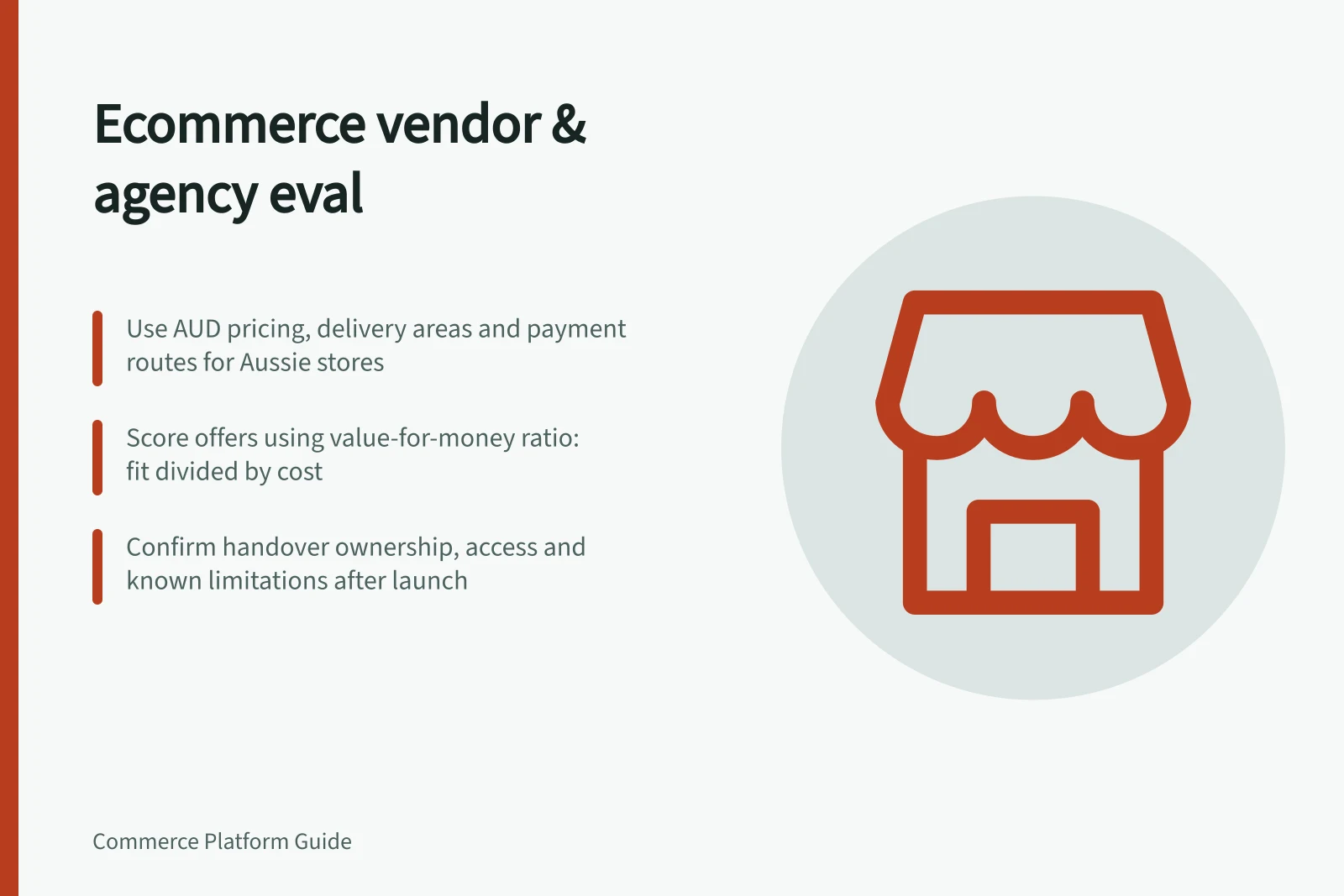
Give each candidate a brief describing the products, customer journeys and staff tasks required at opening. For an Australian store, use the intended AUD prices, delivery areas and payment route. Include an awkward product and an order exception. Mark requirements essential, useful or later, and ask the staff responsible for each essential task to review the result.
| Decision | Evidence to request |
|---|---|
| Platform fit | The required customer and staff outcome in the proposed plan and configuration |
| Delivery fit | Named deliverables, dependencies, exclusions and acceptance criteria |
| Operating fit | Owners for changes, incidents and supplier handoffs after launch |
| Commercial fit | Quotes with one-off work and recurring commitments separated |
| Decision risk | Unshown requirements, assumptions and an owner for each open point |
Compare the combined offer, not isolated scores
Use the same evaluation method for every platform-and-agency pairing. The Victorian Government’s goods and services guide recommends a value-for-money ratio: divide the score for how well an offer meets requirements by its cost, with the highest ratio preferred. This can distinguish a credible delivery-and-ownership plan from an attractive platform proposal on its own.
Weight requirements or groups of requirements by their importance to the store. Set minimum acceptable scores for critical requirements, groups or the total weighted score, so a strong overall result should not conceal a weak essential outcome. Apply the same thresholds to each pairing so suppliers are assessed on equivalent terms.
Do not rely on scoring alone for matters that need due diligence. The guide identifies compliance with the draft contract and supplier viability as examples of issues that may not suit scoring. Check these for both the platform vendor and agency before treating a high evaluation result as a safe choice.
Assess risk across all elements of each offer, including where delivery depends on both suppliers. Consider whether the proposed commitments can be honoured together. Identify any risk that would affect the merchant’s ability to operate the store or obtain help after opening. Keep those checks distinct from the score for meeting requirements.
Separate platform capability from delivery work
Ask the vendor which features and limits apply to the exact plan, storefront and payment route proposed. Ask the agency which apps, custom components and external services it would add, and who would maintain each. A feature available on a platform may still need configuration. A prototype demonstration does not establish that its build is included in the agency’s quote.
Turn broad assurances into deliverables. If delivery rules are “included”, ask which destinations and exceptions will be configured and how the result will be accepted. If an integration is “supported”, ask which supplier will map its fields, monitor rejected records and resolve a failed transfer. Record any responsibility that falls between suppliers.
Key Compliance and Operational Requirements for Australian Ecommerce
- GST for non-resident sellers
- Mandatory registration if selling online to Australia (ATO)
- GST obligations for Aussie sellers
- Apply GST on sales of goods and digital services (Dolman Bateman)
- Payment processing options
- Stripe, Square, PayPal – all support AUD transactions (New Business Website AI)
- Inventory and profit tracking
- Required for ATO compliance and financial reporting (Bentleys)
- Digital marketing agency selection
- Australia-specific expertise recommended (NetStripes)
Connect the demo to the proposal
Give shortlisted suppliers one comparable store scenario and expected outcomes. Record what was shown in the proposed setup, what was supported only by documentation and what remains unresolved. A test payment can show part of the route; it does not establish that the merchant's live account or delivery service is ready.
Place each proposal beside those observations. Check whether it includes the data work, configuration, integrations, staff training, acceptance checks and handover needed to make the demonstrated path usable. A lower quote that excludes an essential handover is not directly comparable with one that includes it. Seek written clarification and keep any revised offer as a separately dated version.
Check the delivery team and handover
Meet the proposed delivery lead and the person who will answer after opening. Ask how they handle a changed requirement, a failed acceptance case and an incident that spans the platform, payment provider and custom code. Request a sample of the handover material: configuration notes, access ownership, known limitations and instructions for routine changes.
References can help establish relevant experience, but ask what work the proposed team actually performed. Keep the final choice in a short record of essential criteria, observed results, committed scope, support ownership and unresolved risks. A supplier is ready for selection when the required path is credible and every remaining dependency has an owner and a route to resolution.
Carry selection commitments into contract management
Before selecting a pairing, check its commitments against the draft contract rather than relying on proposal language alone. Confirm that the terms reflect the work and operating responsibilities the merchant is relying on from each supplier, and resolve any mismatch before accepting the offer.
Confirm that the selected commitments and any agreed conditions remain clear when supplier management begins. Keep unresolved risks visible through that transition, including any dependency that has not yet been settled between the vendor and agency. The selected offer should make clear what has been agreed and what still requires action, so the store team does not mistake an open point for a supplier commitment.
In this guide
- Running the same store scenario in several platform demosUse one realistic store scenario across platform demos and record what was shown, documented or left unresolved.
- Comparing implementation proposals by scopeCompare ecommerce agency proposals by deliverables, merchant dependencies, exclusions, acceptance criteria and quoted price boundaries.
- Reviewing post-launch support arrangementsReview ecommerce support agreements through incident ownership, covered systems, service hours, response targets and supplier handoffs.
- Documenting the platform decision for future teamsCreate an ecommerce platform decision record with the chosen configuration, evidence, trade-offs, open assumptions and review triggers.