Platform Selection
Part of International ecommerce platform capabilities
Evaluating multi-currency pricing controls
Compare converted, adjusted and fixed regional prices by checking display, checkout, payment and refund currencies.
Evaluate multi-currency pricing by tracing an item from its stored price to the amount a customer pays and, later, receives in a refund. A currency symbol on a product page does not establish the checkout currency or whether a regional price is fixed. Write down the intended result for each destination before comparing controls.
Decide which price you need to control
Automatic conversion follows exchange rates. A manual rate controls the conversion used for customer-facing prices but needs regular review. A percentage adjustment changes a group of prices; a fixed product price sets a chosen amount for an item or variant. Use the control that matches the business rule, and assign an owner to regional prices.
For a vendor demonstration, choose an ordinary item and one with a fixed regional price. Record the Australian store price, intended overseas price, displayed currency and checkout currency. Include a promotion and refund. A storefront screenshot alone cannot establish payment conversion, fees or settlement proceeds.
Choosing Between Automatic and Manual Exchange Rates (Shopify)
- Pros of Automatic ConversionReflects real-time exchange movements; requires minimal ongoing management; suitable for businesses accepting fluctuating margins
- Cons of Automatic ConversionUnpredictable customer-facing prices due to volatility; may impact perceived value or margin stability
- Pros of Manual RateEnables fixed local pricing; improves customer trust; supports strategic pricing across markets
- Cons of Manual RateRequires regular review and adjustment; risk of misalignment with actual exchange rates; may lead to lost sales or reduced margins
Compare documented controls and limits
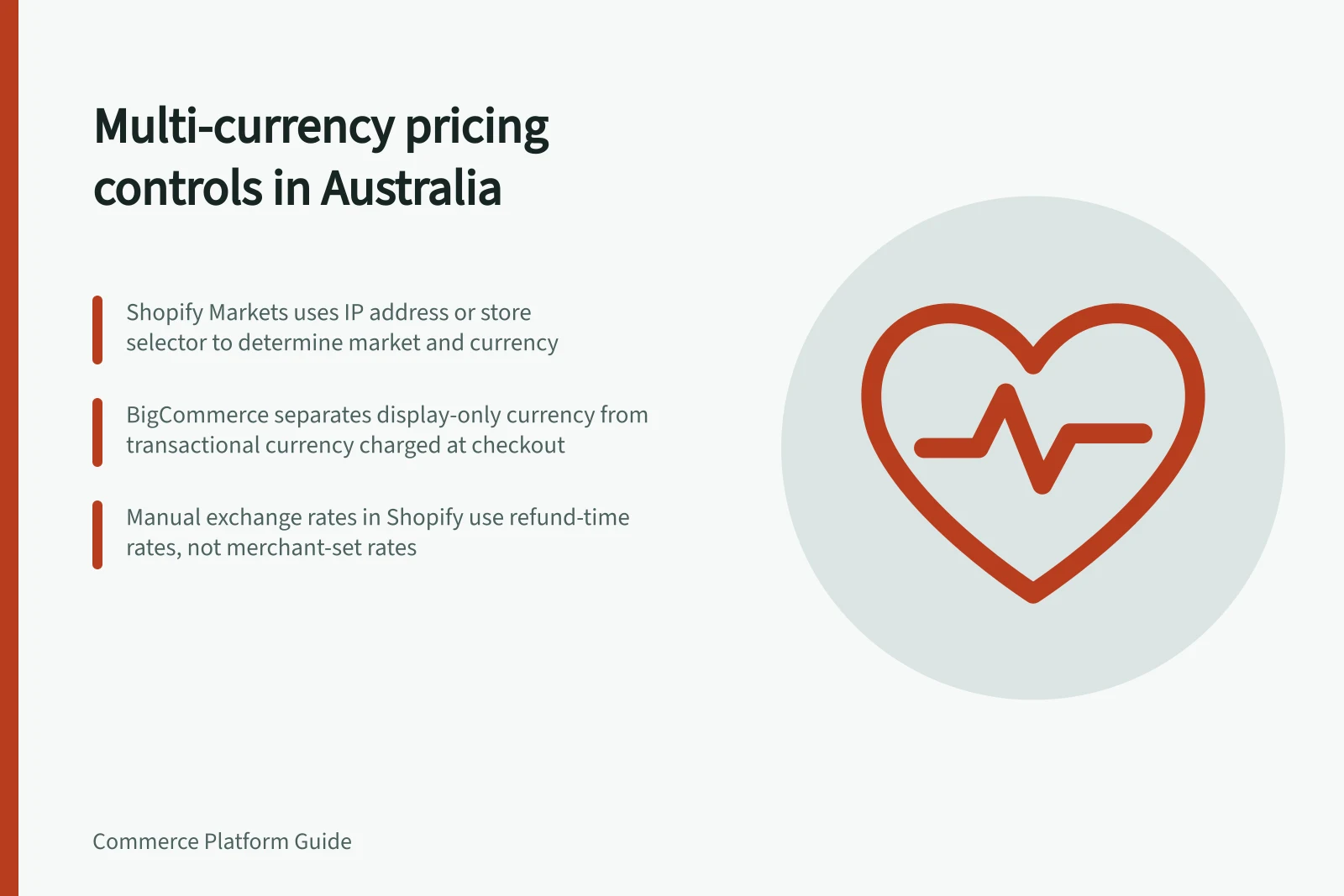
Shopify Markets supports market currencies, automatic or manual exchange rates, rounding, and catalogues with custom prices. Catalogues can include or exclude specific products and set custom prices. In a multi-country market, local currencies are activated by default and can be deactivated.
BigCommerce distinguishes display-only currency from transactional currency. Display-only prices are estimates; checkout charges the store's default currency. A transactional currency is used for both display and charge. Price lists can hold currency-specific variant prices and be assigned to channels or customer groups.
If an active price list lacks a variant price, catalogue pricing applies; when a multi-currency price list is unavailable, BigCommerce documents automatic conversion from the catalogue price. Its documented multi-currency setup specifies a Stencil theme, Optimized One-Page Checkout and a compatible gateway. Check the exact storefront and gateway proposed.
Neither provider's pricing controls establish how every promotion, app or payment method will behave. Ask for those paths to be shown in the proposed configuration.
Inspect every handoff
Point in the journey / Record
- Product page
- Selected market, displayed currency and unit price
- Cart
- Unit price, discount and total after a quantity change
- Checkout
- Currency and amount the customer is told they will pay
- Order record
- Charged currency and recorded amount
- Refund
- Customer refund currency and amount returned
Shopify says markets are determined using a customer's IP address, browser language preferences, market-specific domains, subdomains or subfolders, and any country or language choice made through store selectors.
For Shopify manual exchange rates, refunds use the market exchange rate at the time of refund rather than the merchant's manual rate, so include that outcome in the commercial review.
Choose automatic conversion when exchange movement is acceptable and fixed prices when the business needs a deliberate local price point. Keep display-only currency clearly distinguishable from the currency charged. Base the final decision on the payment and refund path customers will use.