Total Cost
Ecommerce platform costs
Build an ecommerce platform budget covering plans, payment fees, apps, implementation and ongoing support.
An ecommerce platform costs more than its advertised subscription. For an Australian store, compare the cash needed to launch against ongoing costs: platform, payment processing, apps, integrations, hosting where needed, and support. Use identical sales and payment assumptions for every option.
Build a budget you can update
Begin with expected monthly orders, average amount charged, number of payments and payment-method mix. Estimate a quiet month and a busy month too. These inputs show which costs vary with sales, without treating one forecast as certain.
| Cost | Include | Check |
|---|---|---|
| Platform | Plan or software licence | Billing term, tier changes and overages |
| Payments | Processor fees and any separate platform fee | Which payments attract each charge |
| Storefront | Theme, domain and hosting where applicable | One-off and recurring amounts |
| Added capabilities | Apps, extensions and connected services | Usage limits and external billing |
| Implementation | Design, data setup and training | Work excluded from the quote |
| Operations | Updates, monitoring and support | Who does the work after launch |
Record each amount in its quoted currency. Before converting BigCommerce prices to an Australian-dollar estimate, confirm the applicable currency and tax treatment.
Essential Costs to Include in Your Australian Ecommerce Budget
- Platform subscription or licenceConfirm billing term and currency (AUD)
- Payment processing feesInclude percentage + fixed fee per transaction
- Storefront setupDomain, theme, hosting (if not included)
- Apps and extensionsCheck recurring, usage-based, or one-time charges
- Implementation workDesign, data migration, staff training
- Ongoing operationsUpdates, monitoring, security, support (in-house or outsourced)
Compare the cost structures
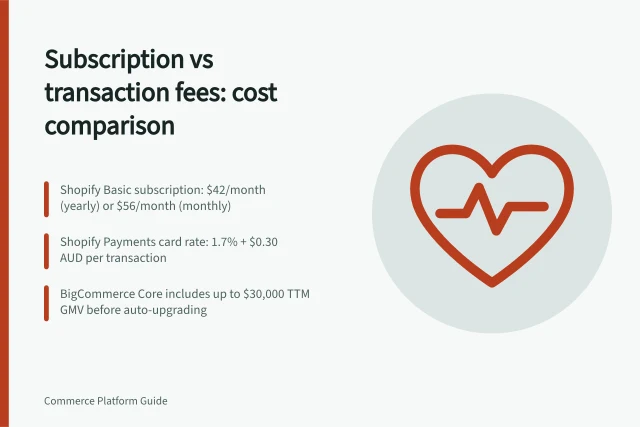
Shopify Shopify Payments card rates start at 1.7% + 30¢ AUD on Basic, 1.55% + 30¢ AUD on Grow, 1.35% + 30¢ AUD on Advanced and 1.15% + 30¢ AUD on Plus. A dearer plan may reduce an applicable payment rate, but the saving depends on the store’s payment mix and must be weighed against its subscription and feature needs.
BigCommerce also offers hosted plans, but sales can change plan cost. Its Core and Growth thresholds use trailing-12-month GMV and can trigger an automatic upgrade. Scale has a monthly GMV allowance and an overage rate.
Orders through providers in its Embedded Payment Provider programme have no additional BigCommerce order fee. Before modelling this cost, check the current provider classification and BigCommerce’s GMV definition.
WooCommerce has no subscription for its core WordPress plugin or core platform transaction fee. The store still needs hosting, a payment provider and any required paid extensions. Budget for someone to maintain the site and resolve problems, whether done in-house or purchased.
Payment Processing Fees: Shopify vs BigCommerce (AUD)
- Shopify Payments – Basic Plan1.7% + 30¢ per transaction
- Shopify Payments – Grow Plan1.55% + 30¢ per transaction
- Shopify Payments – Advanced Plan1.35% + 30¢ per transaction
- Shopify Payments – Plus Plan1.15% + 30¢ per transaction
- BigCommerce Embedded Payment ProvidersNo additional platform order fee
Check published prices and billing terms
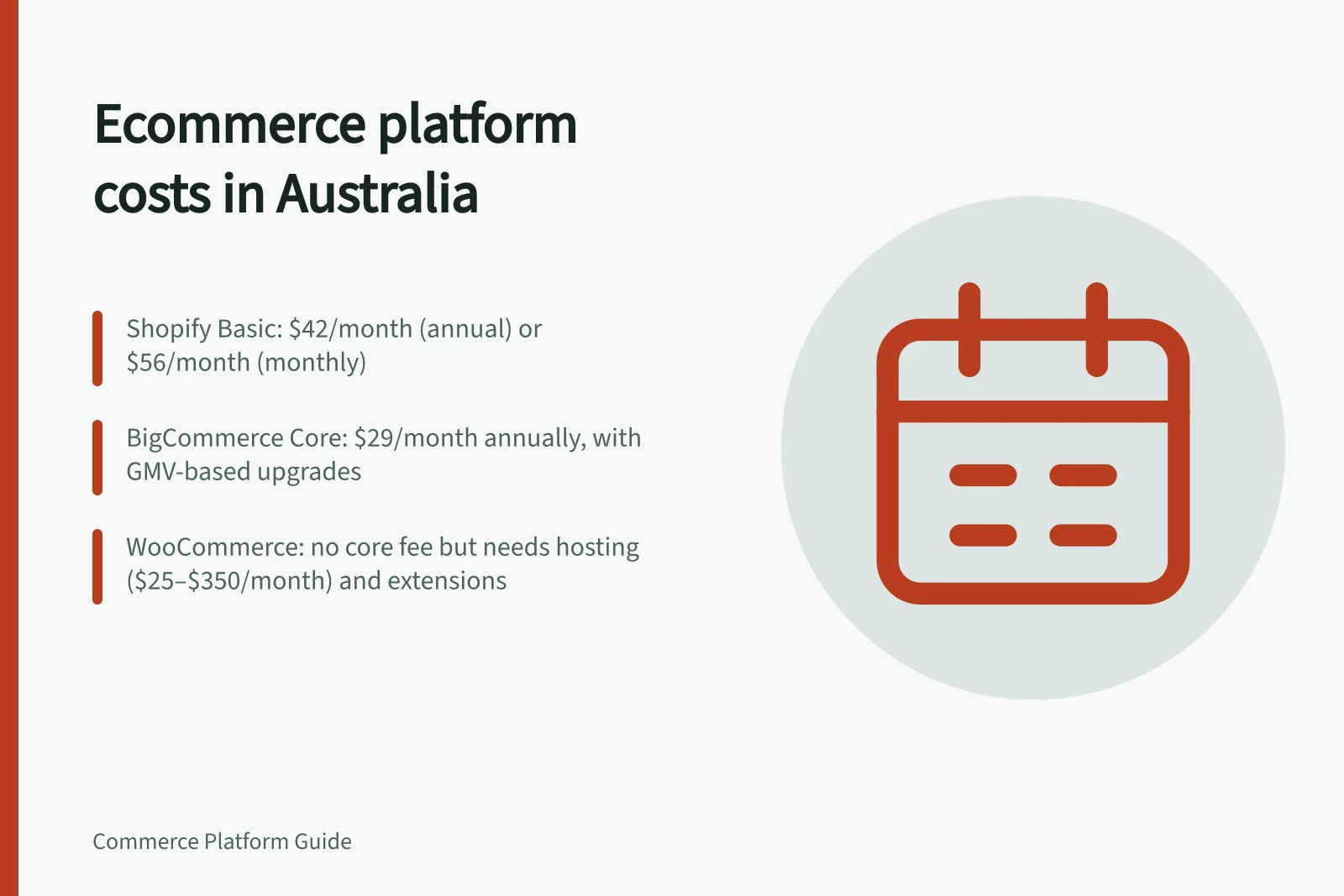
Shopify Basic costs $42 a month when paid yearly, or $56 month to month; Grow costs $114 a month, Advanced $431 a month and Plus from $3,700 a month on yearly billing. Compare payment commitment and cost over the same period; don’t treat a promotional offer as the ongoing subscription price.
BigCommerce Core costs $29 a month, Growth $79 and Scale $299 when billed annually; Performance is custom-priced from $1,499 a month when billed annually. Its pricing page advertises savings with annual billing, so include the billing commitment in the comparison. Performance also includes a dedicated Customer Success Manager and 24/7 live phone and chat support.
Shopify lists POS Pro as an add-on for $129 a month for physical storefronts. Include it only if the proposed store needs those additional in-store capabilities.
Ecommerce Platform Cost Comparison for Australian Stores (Annual Billing)
- Platform
- Shopify Basic
- Monthly Cost (Annual Billing)
- $42 AUD
- Platform
- Shopify Grow
- Monthly Cost (Annual Billing)
- $114 AUD
- Platform
- Shopify Advanced
- Monthly Cost (Annual Billing)
- $431 AUD
- Platform
- Shopify Plus
- Monthly Cost (Annual Billing)
- $3,700 AUD
- Platform
- BigCommerce Core
- Monthly Cost (Annual Billing)
- $29 AUD
- Platform
- BigCommerce Growth
- Monthly Cost (Annual Billing)
- $79 AUD
- Platform
- BigCommerce Scale
- Monthly Cost (Annual Billing)
- $299 AUD
- Platform
- BigCommerce Performance
- Monthly Cost (Annual Billing)
- $1,499 AUD
- WooCommerce
- No subscription fee
- Extensions (Estimated Annual)
- $29–$299 AUD
Allow for WooCommerce’s chosen services
Hosting for most stores costs $25–$350 a month; extensions cost $29–$299 a year per extension. Treat these as planning figures; then confirm the currency and current price for the services selected before converting them to an Australian-dollar budget.
WooCommerce.com product assistance is available through documentation, live chat or a support ticket; phone support is unavailable. Support for the core WooCommerce plugin is provided through the WordPress.org support forum.
Separate the payment lines
A processor may charge a percentage of the payment plus a fixed amount per payment. A platform can add a separate fee under particular provider arrangements. Do not apply one card rate to all orders: estimate material payment categories separately and check terms for refunds, disputes and currency conversion.
Price the work between systems
List the tasks the store must perform, from product updates to fulfilled orders. Mark what the proposed plan already covers and what needs an app, extension or connection. For each addition, record its subscription or licence, usage basis, setup cost, renewal terms and support owner.
App charges can be recurring subscriptions, usage-based charges or one-time purchases. App subscriptions and usage charges are included in Shopify’s regular subscription bill; one-time purchases are billed separately.
Shopify subscription invoices are issued every 30 days and paid in advance for the upcoming period. App subscriptions and usage charges can have a separate 30-day billing cycle, so an app charge may not align neatly with the platform invoice.
Compare launch year and later years
Show one-off implementation work separately from recurring charges. A first-year total captures the cash needed to open; a later-year estimate captures renewals, processing, hosting and support. Keep an unquoted line marked unknown and update the estimate when sales, payment methods or plan tiers change.
Top Ecommerce Platforms by Total Cost of Ownership (Australia)
- Shopify (Basic)Lowest entry cost; ideal for small stores with <50 monthly orders
- BigCommerce (Core)Balanced pricing; scalable with GMV; suitable for mid-sized businesses
- WooCommerceLowest base cost but high variable costs for hosting and maintenance
- Shopify (Advanced/Plus)High cost but comprehensive features; best for large or complex stores
- BigCommerce (Performance)Premium support and scalability; ideal for enterprise-level operations
In this guide
- Subscription fees versus transaction charges: compare costsSeparate ecommerce subscriptions, payment processing and platform transaction fees before comparing plans.
- Estimating app and integration costs before launchBudget for app subscriptions, usage fees, setup, data mapping and support before opening an ecommerce store.